Low Water Levels on the Rhine: How Modern Ship Designs Strengthen Security of Supply
13.08.2026 | Salzgitter Flachstahl GmbH
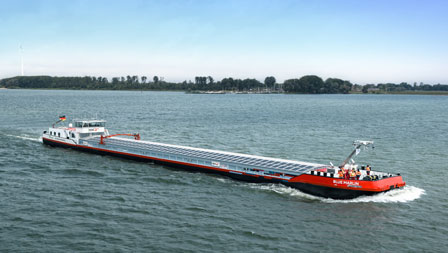
At Salzgitter Flachstahl, we are closely monitoring the recent media reports on the extremely low water levels on the Rhine. Low water levels pose particular challenges for inland waterway shipping and, consequently, for industrial supply chains.
This makes the value of our decision to invest early on, together with our partners, in modern, low-draft-optimized vessel designs all the more evident.
One example of this is the Blue Marlin, which we have chartered:
- 86 meters long and 9.50 meters wide
- capable of navigating in waters as shallow as approximately 1.10 meters
- Up to 3,110 metric tons of transport capacity when combined with a push barge
- Diesel-electric “Future-Fuel-Ready” propulsion system
- Solar power system with a potential output of up to 37,500 kWh per year
The Blue Marlin is deployed across the entire group. It transports raw materials and products not only for Salzgitter Flachstahl, but also for our sister companies Ilsenburger Grobblech GmbH and Peiner Träger GmbH. In doing so, it makes an important contribution to supply security and the efficient coordination of material flows within Salzgitter AG.
Low-water optimization really comes into its own under current conditions. While some routes remain challenging due to infrastructure constraints in the canal area, the low water levels have so far been relatively manageable for our vessels, which are designed specifically for these conditions.
For us, this is an important confirmation: Our joint investments with HGK Shipping in modern, efficient, and low-water-optimized inland waterway vessels were and remain the right approach. At the same time, this can only be a start.
Current water levels show that low-water events are no longer merely temporary exceptions. They are increasingly becoming a permanent planning factor for industry and logistics. This makes it all the more important to adapt transport concepts to changing conditions at an early stage and to build resilience in a targeted manner.
If we want to ensure the industry’s ability to deliver in the future and maintain waterways as an efficient mode of transport, further investments are needed—ones that go beyond individual companies and projects.
Shipping companies, shippers, and industry must work together to continue modernizing fleets and investing in vessels that can be operated economically even under increasingly challenging water levels. However, modern vessels alone are not enough. The performance of inland waterway transport also depends entirely on the infrastructure. Locks and lift locks, in particular, are critical elements for safe and reliable supply chains. Anyone who wants to maintain waterways as a strong mode of transport must therefore invest equally in fleets, waterways, and infrastructure.
After all, resilient supply chains are not created by short-term reactions to low water levels. They are created through long-term investment decisions, technological innovations, and strong partnerships that ensure security of supply even under changing climatic conditions.
The Blue Marlin demonstrates what is already technically possible. Now we must continue down this path together and at a faster pace.