Optical strain analysis for extended determination of material ductility
23.10.2019 | Salzgitter Mannesmann Forschung GmbH
The number of different types of steel has risen steadily over the last few years and decades. Many new steel grades have come onto the market, particularly high-strength and ultra-high-strength steels, some of them optimized for specific applications. SZFG’s xpand® grades offer one such example as they have been designed to ensure low susceptibility to edge cracks. It used to be possible to describe the ductility of a material almost exclusively by means of key characteristics such as fracture elongation and the n and r value from a classic tensile test, and to use forming limit curves to estimate the manufacturability of a component. With many modern, high-strength and ultra-high-strength steels, this description is no longer sufficient to unambiguously differentiate their spectral properties. The main reason for this is that many of these modern steel types can be heavily deformed locally by comparison with classic steel grades while retaining their same strength – a property which is significant, for example, when forming a tight radius and which cannot be registered by conventional ductility characteristics or not with sufficient accuracy.
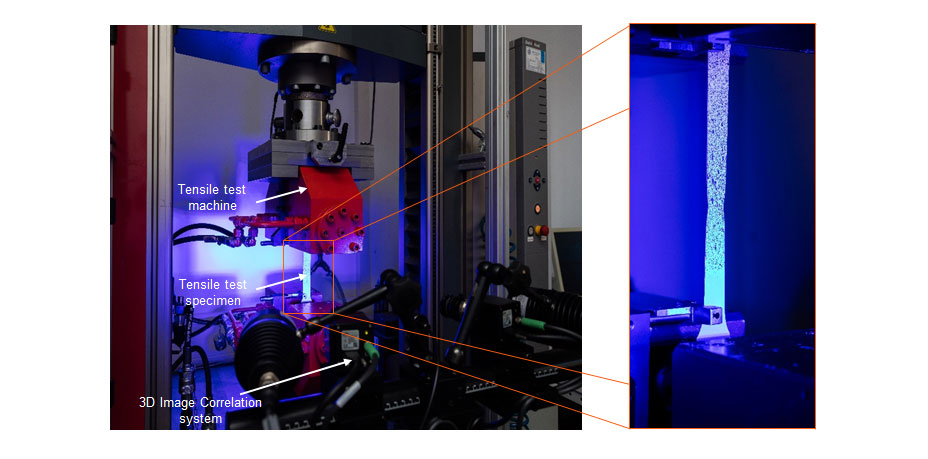
It is therefore essential to determine local material characteristics for a complete description of a material’s ductility. Contactless, optical strain analysis based on the measurement principle of digital image correlation (DIC) represents one tried and tested method of accomplishing this. Fig. 1 shows an existing test set-up at Salzgitter Mannesmann Forschung (SZMF) for a 3D image correlation system on a tensile test machine. A stochastic pattern is applied to the surface of the object to be measured before the test begins. The shifts and deformations of the pattern are recorded by a stereo camera system across the trial and calculated by means of software. The 3D shifts and corresponding surface elongations can thereby be determined over the entire area.
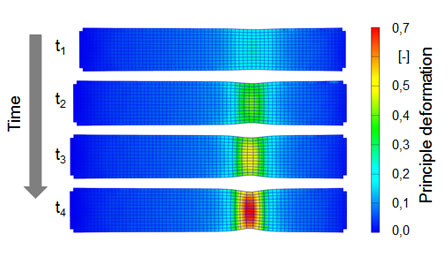
The elongation characteristics at different times of the tensile test carried out at a constant strain rate, are shown in Fig. 2 by way of an example. The localization of the elongation starting from a specific strain on the test specimen is clearly visible.
The strain distribution shortly before cracking along a longitudinal section line on the specimen is shown in Fig. 3 for the bainitic hot strip HR-BS800 and the ferritic-bainitic hot strip HR-FS800 as well as the two cold rolled strip grades CR-CP800 (complex phase steel) and CR-DP800 (dual phase steel). Clear differences between these four materials can be discerned with regard to the maximum local elongation. While the HR-BS800, HR-FS800 and CR-CP800 materials show pronounced localized elongation, the dual-phase steel, on the other hand, exhibits comparatively high elongation over the entire length of the specimen but only small localized necking.
This use of optical measurement technology in Salzgitter generates a thorough understanding of the material’s ductility. This permits even more targeted material selection with regard to specific questions raised by customers.
