Quality Assurance in Refractory Technology
22.07.2026 | Salzgitter Flachstahl GmbH
In an integrated steel mill such as Salzgitter Flachstahl, numerous auxiliary materials and products are required in addition to raw materials such as ore, coal, and scrap. Refractory materials are indispensable in the steelmaking process; their primary function is to protect the equipment during high-temperature processes.
Refractory products are defined as non-metallic, ceramic materials with a cone drop temperature of ≥ 1500 °C. In practice, however, all materials used in a temperature range from 600 °C to 2000 °C are referred to as refractory.
Refractory materials are not only crucial for the functionality of the equipment but also a significant consumable that must be continuously replaced. The costs of refractory materials are substantial and have a major impact on the economic efficiency of operations. Therefore, optimizing the service life and efficiency of these materials is of great importance for reducing steel production costs and increasing profitability.
Refractory Materials: Indispensable in the Steelmaking Process
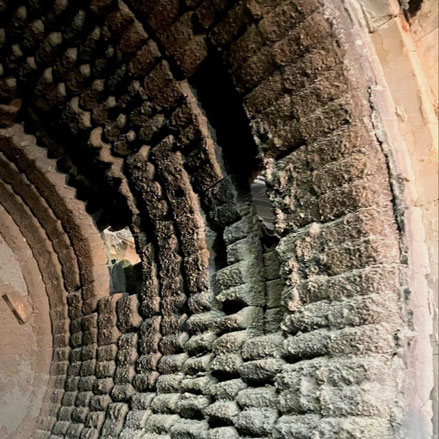
Various types of refractory products are used within Salzgitter Flachstahl. These materials are subject to constant and predictable wear over the service life of a piece of equipment, which can range from weeks (ladle) to months (converter) to years (blast furnace, DRP plant). A key aspect of their use is protecting the units from premature failure or damage, which is why quality assurance tailored to operational conditions is essential.
Nevertheless, premature failures of high-temperature units can also occur, making failure analysis another important task of quality assurance.
Quality Assurance and the Role of the Refractory Laboratory
Salzgitter AG operates its own refractory laboratory, equipped with refractory expertise and testing know-how, for suitability testing and quality control. The direct connection between the in-house refractory laboratory and the production facilities enables immediate assessment and discussion. This allows for a quick and precise analysis of the causes and the development of customized solutions to optimize refractory materials, which ultimately leads to cost reductions and increased efficiency. To achieve this, the cause must first be understood through systematic analysis.
Wear Mechanisms and Influencing Factors
Generally, there are three main mechanisms of wear in refractory materials: mechanical, chemical, and thermal wear, which can also occur in combination. Therefore, it is crucial in any analysis to know or inquire about the process conditions. By asking specific questions—for example, about the maximum process temperature or the use of other raw materials for smelting, i.e., deviations from standard process parameters—initial clues as to the cause can be identified. These questions can be posed and discussed quickly and directly through collaboration between the plant’s in-house refractory laboratory and the production facilities.
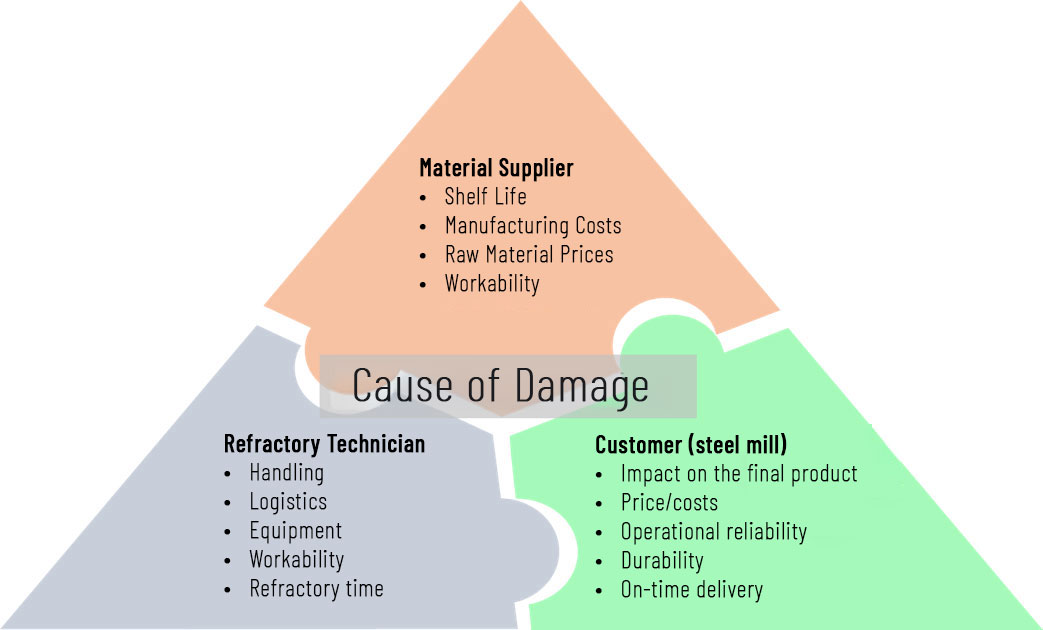
In addition to the three main wear mechanisms, there are three other factors that influence the use of refractory materials: the material supplier, the delivery of the aggregates, and the user. On the part of the material supplier, inhomogeneous mixtures, incorrect or contaminated raw materials, pressing errors, or foreign matter can negatively impact quality and, in the worst case, lead to damage. Furthermore, significant quality losses can occur even during material storage, such as when sol-gel binders are stored in freezing conditions. The use of too much or too little water in refractory concretes can also lead to cracking or dry pockets. When installing molded refractory products, joint width and the dimensions of the keystones are important. Finally, the user of the refractory material plays a decisive role, as the materials in the steel mill are often exposed to extreme and fluctuating conditions that can lead to premature wear.
Systematic Analysis for Stable Processes
The analysis follows a defined sequence: First, information is gathered regarding a failure or reduced service life. This is then documented to precisely identify the affected areas within the units. Samples are taken and the operating conditions are discussed; in this context, unused material is advantageous as a reference sample for assessing material quality and for comparison with the data sheet. The results of the quality controls and data sheets are compiled. After reviewing and evaluating the available information and discussing the operating conditions, the appropriate tests are selected. Hypotheses often emerge at this stage, which are then verified through targeted investigations. For example, chipping at the corners of bricks may indicate expansion problems, which are then verified through appropriate tests. The refractory laboratory at Salzgitter AG offers a wide range of testing capabilities and possesses extensive expertise in various materials. Finally, the measured results are evaluated in light of the hypotheses, a cause is identified or re-examined, and, if necessary, further investigations are scheduled. Once the cause has been determined, discussions on optimization can be held with the responsible parties to prevent future damage.
Collaboration between colleagues on-site and in the laboratory is essential to minimize the scope of testing and to perform only the specific analyses necessary to test the hypotheses that have been formulated. The expertise of the refractory specialists and the capabilities of the in-house laboratory are crucial for the continuous improvement and adaptation of refractory materials to the specific requirements of the steel mill, which ultimately leads to a reduction in operating costs and an increase in efficiency.