IIoT Increases Transparency in Materials Testing
11.11.2026 | Salzgitter Flachstahl GmbH
Digital tracking of test specimens accelerates the delivery of quality-relevant test results
Before a material leaves our facility, we must ensure that its mechanical and technological properties meet the agreed-upon requirements. Material testing by the Technical Customer Advisory Service plays a central role in this process: In an accredited testing laboratory, test specimens are fabricated from test sheets and subjected to destructive testing. The material’s release status is determined based on these results. This status is an essential prerequisite for shipping, certificate issuance, and invoicing.
However, the flow of quality-related information does not begin in the laboratory. The foundation is an overarching inspection lot planning process that takes into account both customer-specific requirements for certificates and test documentation as well as internal quality control. In accordance with this plan, test sheets are taken from the production lines, collected in transport containers, and regularly transported to the central testing laboratory. Approximately 100 of these containers are in circulation within the company.
From Transport Container to Digital Information Carrier
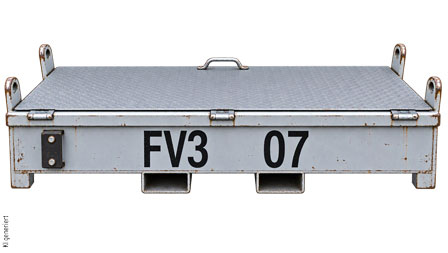
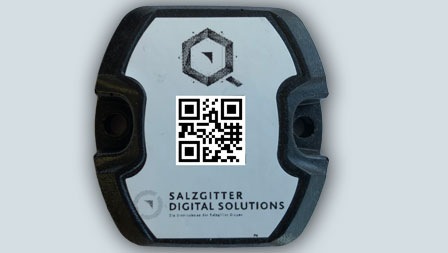
To transparently track the path of samples between production and the lab, the transport containers were equipped with Bluetooth beacons. The beacons transmit a unique identifier at short intervals. Fixed scanners at the sampling stations and in the approach zone of the sample processing area capture these signals. The relevant information is centrally provided and processed via the IIoT (Industrial Internet of Things) infrastructure.
Technically, this combines the strengths of two wireless technologies: Bluetooth is suitable for the energy-efficient identification of objects at close range. LoRaWAN (Long Range Wide Area Network) is a low-power wide-area architecture designed for transmitting small amounts of data over long distances and for scalable IIoT networks. The technology enables battery-powered devices with low energy requirements to be wirelessly integrated into extensive IIoT networks that can be expanded as needed.
The solution implemented deliberately does not rely on continuous, meter-accurate tracking. Instead, it reliably records when a tagged transport container arrives at or departs from a defined station. The arrival and departure times of the container are derived from the received signals. Since the sampling event is also recorded digitally at the same time, the respective sample sheet can be uniquely assigned to its transport container. The container thus serves as the digital link between the manufactured part, the sampled sheet, and the subsequent inspection.
The system integration of the Bluetooth components, as well as the development of a dashboard for monitoring the IIoT infrastructure, were carried out by our sister company, Salzgitter Digital Solutions GmbH. By combining expertise in materials testing and process engineering with the Group’s internal digitalization and integration capabilities, a comprehensive solution tailored to operational requirements was created.
Greater Transparency for a Reliable Approval Process
Our customers benefit from indirect added value, primarily through greater transparency throughout the entire testing process. The status of a sample is visible not only upon its arrival at the laboratory. The transition between sample collection, internal transport, and sample preparation is already digitally tracked. This allows delays and unplanned downtime to be identified more systematically and analyzed in a targeted manner.
The recorded timestamps also create a robust data foundation for the continuous optimization of the process chain. Transport cycles, handoff processes, and the preparation of samples for testing can be objectively evaluated. The goal is to further shorten the turnaround time from sample collection to the availability of test results. Faster test results, in turn, support early material release and thus reliable processes for shipping, certificate issuance, and invoicing.
The central dashboard for monitoring the technical status of the IIoT infrastructure also provides a quick overview of component availability and, for example, alerts users early on to low battery levels in individual beacons. This allows for the planning of necessary battery replacements before traceability is compromised.
Connected Quality Assurance with Clear Customer Benefits
The IIoT solution links physical sample movements with digital process information. It thus not only increases transparency within materials testing but also strengthens the robustness of the quality-related approval process.
For our customers and our processes, this means:
- traceable and digitally supported testing procedures,
- early detection of delays,
- a solid foundation for shorter turnaround times,
- greater reliability in material approval and certificate issuance,
- and continuous, data-driven optimization of the process chain.
In this way, the Industrial Internet of Things becomes a practical tool for quality assurance: not as an isolated technological solution, but as an integral part of an end-to-end process chain—from the produced material through the test sheet to the quality-assured test result.