Profile Analysis on the Hot-Rolled Wide Strip Mill
19.08.2026 | Salzgitter Flachstahl GmbH
![[Translate to Englisch:] Foto einer Bramme](/fileadmin/footage/MEDIA/presse/szfg/2026/08/Bramme_448.jpg)
At Salzgitter Flachstahl’s hot-rolled wide strip mill, slabs from the continuous casting lines are rolled into hot-rolled wide strip and wound into coils. To do this, the slab is heated to rolling temperature in one of the reheating furnaces and then rolled to the desired thickness through several rolling stands.
The Thickness Profile
During the rolling process, the material acquires a thickness profile depending on the shape of the rolls and their positioning through bending/swiveling, as well as the temperature. This profile describes the variation in thickness across the strip width. A rough distinction is made between flat, concave, and convex profiles, although hybrid forms may also occur.
Depending on the type and severity of the profile variations, different behaviors result—for example, regarding oil distribution or strip runout in downstream processes. In particular, a more convex profile is advantageous for cold rolling, whereas a flatter profile is preferred for oil distribution.
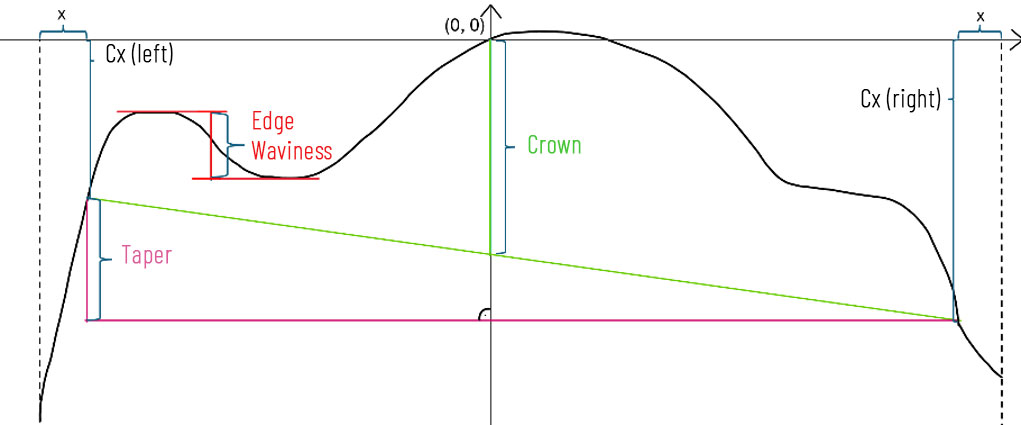
Depending on the application, different requirements apply to the profile, which are described by various parameters. For example, the Cx value (e.g., C40 or C100) describes the degree to which the strip thickness at a defined distance from the strip edge deviates from the thickness at the strip center. Connecting the two measurement points creates a profile line. Two additional characteristic profile values can be determined from this line: the crown and the wedge.
The crown is the difference between the standardized zero point and the vertical intersection with this connecting line. The wedge is the absolute difference between the two Cx values on the left and right sides of the strip (see figure).
In addition, so-called beads may occur, which describe an increase in thickness at the strip edges. If the bead is too pronounced, edge waviness can occur during cold rolling.
The Data System for Materials Development and Quality (DEWuQ)
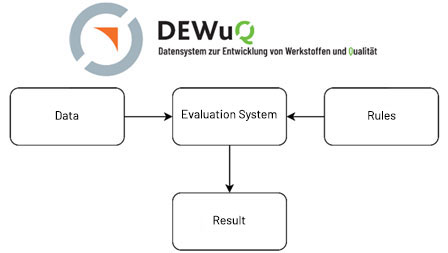
With the introduction of “DEWuQ,” the data system for materials development and quality, it became possible for the first time to conduct a plant-wide assessment of production quality across all production lines. DEWuQ features an internal set of rules that evaluates products according to defined criteria and blocks them for manual review if the specifications are violated.
With increasing system capabilities on the one hand and new requirements on the other (e.g., analysis of the bead), the task arose to integrate profile evaluation into the DEWuQ system as well.
Based on thickness measurement records, the implemented rules check after hot rolling whether the specifications regarding crown, wedge, and bead have been met in accordance with the customer’s order-specific requirements.
For the evaluation, the selected measurement records are first normalized to the zero point as described above, so that the profile records are set to (0, 0) at the center of the strip. Subsequently, depending on the profile designation, crown and wedge are calculated using the C40 or C100 points. After the wedge has been factored out, the normalized thickness record is checked for bulges.
Overall, this change in profile evaluation enhances process reliability regarding the profile properties of the hot-rolled strip and ensures consistently high quality for customers. At the same time, it supports the work of the quality evaluator, as a significant portion of the produced strips can already be characterized automatically, meaning that only strips with deviations need to be manually evaluated by the quality evaluator.